






Sustainability in the iGaming Industry

The iGaming industry is experiencing significant change nowadays. A sector that was once defined mainly by digital entertainment and rapid expansion is now being reshaped by a new and unavoidable priority: sustainability.
Sustainability in iGaming has moved beyond being a corporate social responsibility (CSR) initiative or a marketing concept aimed at consumers. It has become an essential part of business strategy that influences environmental impact, player protection measures, and marketing approaches.
As global competition intensifies and technological progress continues, iGaming operators are adapting their operations to better support both society and the environment. This article examines how sustainable iGaming is developing from a theoretical concept into a practical operational framework that supports long-term business stability and responsible leadership.
Key Drivers of Change
First, increasing competition in the global gambling market has made it more difficult for operators to distinguish their brands. As products and services become more similar, a company’s ethical position and sustainability strategy play a more important role for modern customers and socially aware players.
Second, technological progress presents both challenges and opportunities. The growing data requirements of modern gaming platforms increase energy consumption, yet technologies such as artificial intelligence and cloud computing provide new tools for monitoring environmental impact and improving player protection.
Finally, expectations from investors and stakeholders have reached a decisive stage. Institutional investors increasingly evaluate companies using environmental, social, and governance (ESG) indicators to assess risk management and long-term sustainability. Although there are no specific environmental laws designed solely for iGaming, broader regulatory initiatives such as the EU Corporate Sustainability Reporting Directive (CSRD) and the Energy Efficiency Directive (EED) are already influencing the sector.
Three Key Pillars of Sustainable iGaming
Sustainability in iGaming is commonly analysed through the ESG framework, which includes environmental, social, and governance principles.
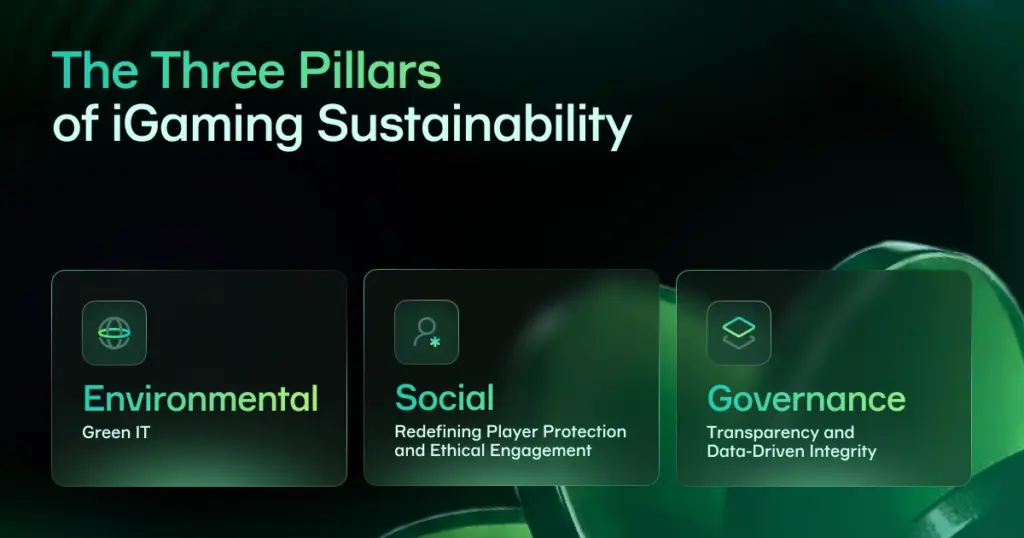
Environmental Sustainability: Green IT
The environmental impact of online gambling is often underestimated because it is not physically visible in the same way as traditional casinos. Land-based establishments clearly consume resources through lighting, heating, and physical waste generation, while the environmental footprint of iGaming is largely digital and located within extensive networks of servers and data centres.
As demand grows for high-definition streaming and real-time data processing, the energy required to maintain these services also increases. As a result, the industry is increasingly focusing on green IT as a key component of corporate sustainability.
Social Aspect: Rethinking Player Protection and Ethical Engagement
Within the sustainability framework, the social component is often considered the most important for the long-term viability of the industry. Environmental initiatives focus on protecting the planet, while social initiatives focus on protecting the players who form the core of the business.
A sustainable iGaming industry ensures that entertainment does not negatively affect player wellbeing. This perspective has encouraged operators to move from reactive safety measures toward proactive responsible gaming systems integrated into the user experience.
Social sustainability also extends to internal company practices, including diversity, equity, and inclusion initiatives within the workforce as well as participation in community programmes. These actions help strengthen brand credibility and contribute to long-term trust among players, partners, and stakeholders.
Governance: Data-Driven Transparency and Integrity
In sustainable iGaming, governance has developed from a simple compliance requirement into a fundamental component of business stability. While environmental and social initiatives focus on impact, governance ensures that these efforts are measurable, transparent, and accountable.
For modern operators, transparency plays a central role in establishing trust with regulators, investors, and players.
By 2026, ESG reporting and structured internal policies have become standard practice among many industry leaders. One example is the MGA ESG Code of Good Practice, which offers a framework for reporting environmental and social performance.
Through annual sustainability reports, operators present measurable data related to their ESG initiatives. This may include gender pay equality statistics, carbon emission reductions, and the effectiveness of responsible gaming policies.
Such transparency is increasingly important for investors, who rely on ESG indicators when evaluating long-term financial risk and sustainability.
Soft2Bet and Sustainable Development
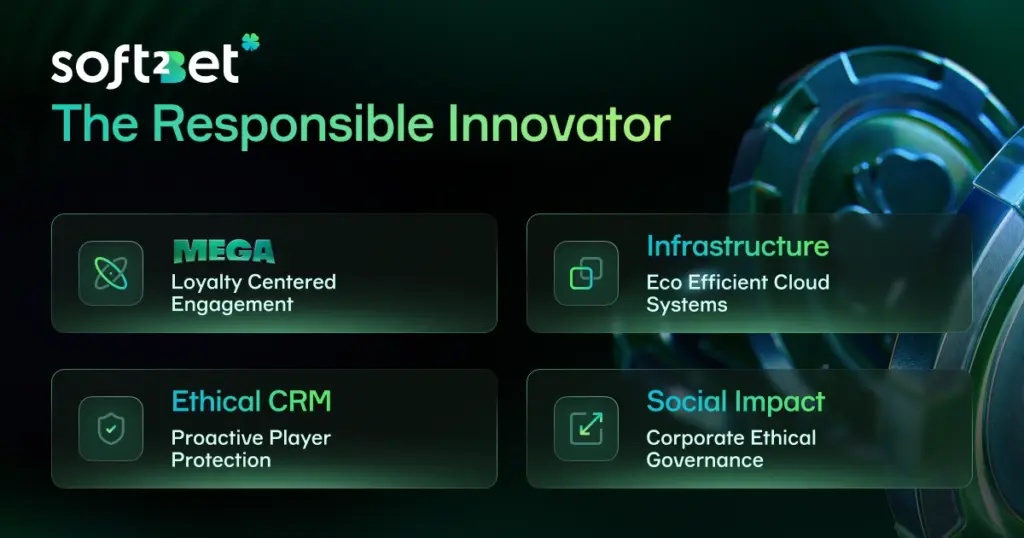
Soft2Bet presents itself within the industry as a responsible innovator and integrates sustainability principles into several key areas of its business model.
- Motivational Engineering Gaming Application (MEGA): The MEGA platform functions as a gamification engine designed to improve long-term player engagement. Instead of relying heavily on bonus-driven marketing campaigns, the system focuses on building sustainable interaction models that prioritise long-term user participation.
- Cloud-based infrastructure:The company’s transition to cloud-based infrastructure has contributed to lower energy consumption while maintaining high technical performance. This demonstrates that advanced technology infrastructure can operate with improved environmental efficiency.
- Responsible gambling through ethical CRM: Soft2Bet also uses customer relationship management tools supported by data analysis to detect potentially harmful behaviour patterns at an early stage. This approach allows the company to move from reactive responses to proactive player protection.
- Social responsibility: The company’s sustainability strategy also includes social initiatives and charitable contributions. These activities support broader organisational values related to ethical governance and inclusion.
The Current Legal Framework
At present there is no unified global environmental regulation specifically targeting the iGaming industry. However, regional regulations and voluntary sustainability frameworks are gradually forming a structure that operators must consider.
For companies operating within the sector, this environment requires proactive planning to ensure that infrastructure and operational models remain compliant with future regulatory expectations.
EU rules and the energy mandate: Operators active in European markets increasingly face pressure connected with the EU Energy Efficiency Directive (EED). While originally focused on heavy industries, the directive now also applies to digital service providers.
Beginning in 2026, data centres with an installed IT capacity of 500 kilowatts or more must report detailed energy efficiency information to a central European database.
- Large iGaming platforms must therefore disclose data such as total energy consumption, power usage effectiveness (PUE), and even water usage associated with cooling systems.
- For companies headquartered in the European Union, the Corporate Sustainability Reporting Directive (CSRD) introduces additional requirements. Organisations must provide “double materiality” reporting, explaining both how sustainability factors affect financial performance and how the company’s digital operations influence the environment.
Voluntary codes as a competitive “seal of approval”: In the absence of strict global regulations, some regulatory bodies have introduced voluntary frameworks to encourage responsible practices. One example is the ESG Code of Good Practice developed by the Malta Gaming Authority (MGA). Although participation is voluntary, the framework allows licensed operators to report performance across 19 environmental, social, and governance areas.
In practice, this initiative has become an important industry standard. Operators that receive the MGA ESG Code Approval Seal benefit from improved relationships with banks, insurance providers, and business partners that are also required to meet European sustainability reporting standards. In many cases, holding this certification strengthens a company’s position when applying for licence renewals or entering new markets.
Moving from voluntary initiatives to regulatory requirements: Industry trends suggest that sustainability requirements will gradually become mandatory components of licensing frameworks. By the end of the decade, it is widely expected that environmental impact and sustainability performance will be evaluated alongside existing regulatory criteria such as Anti-Money Laundering (AML) and Know Your Customer (KYC) procedures.
- The sector may eventually move toward a “green licensing” model in which operators must demonstrate carbon reduction targets or strong responsible gaming frameworks as part of their compliance requirements.
- For iGaming companies, the strategic decision is increasingly clear: adapt to sustainability standards early or face higher compliance costs and potential regulatory risks in the future, including financial penalties or possible licence restrictions.
Conclusion
The future of sustainable iGaming will depend on the integration of compliance systems, technological innovation, and ethical business practices.
For companies such as Soft2Bet, the focus is already shifting toward responsible gambling tools supported by advanced analytics and energy-efficient technological infrastructure. As regulations continue to evolve, introducing stricter environmental and social reporting standards, the operators that succeed will be those that treat sustainability not as a regulatory obligation but as a foundation for long-term innovation and trust.